
Both build software with AI agents and let you step back. They are not the same product, they are not for the same person, and the difference comes down to one question: when the work is done, who decided that, and can you trust them?
What Devin does
Devin, by Cognition, is an autonomous AI software engineer. You give it a task, it plans, writes code, runs tests, fixes what fails, and ships, all inside its own cloud sandbox with a terminal, an editor, and a browser. By 2026 it re-plans on the fly and, on well-defined tasks, runs unsupervised. In one published trial it completed 31 of 38 dependency upgrades over a weekend with nobody watching.
Credit where it’s due. That’s real, it’s polished, and it’s backed by a large, well-funded team. For a senior engineer handing off well-scoped work, Devin is a genuine force multiplier, and more mature than anything we’ll claim here.
What PaellaDoc does
PaellaDoc also runs autonomously, end to end. In no-coder mode you describe the product, and it turns that into requirements, a plan, tasks, and working software, orchestrating coding agents (Claude, Codex, Kimi, whichever you have) underneath. Three deliberate choices set it apart:
- It runs local, and you pick the agent: a cloud one (the code goes to that provider, like using it directly) or a local model (nothing leaves your machine).
- It’s model-agnostic. It uses the agents you already pay for and routes per task, instead of locking you to one vendor’s model.
- Nothing reaches done until it passes an independent verification gate. The code is executed against the acceptance criteria, and a green build is not enough.
The difference that matters: who grades “done”
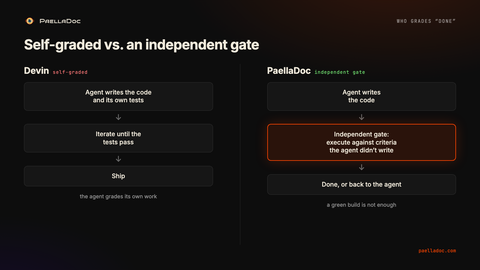
Devin’s loop is: write the code, run the tests, if they fail iterate until they pass, then ship. The catch is that the agent wrote the code and the tests. It is grading its own homework.
We measured what that’s worth. Across 210 runs, a coding agent’s output passed the build but was genuinely wrong 40% of the time. Even the strongest frontier model at maximum effort shipped a real bug on a hard task two out of three times, on different runs each time. A green build is not a correct feature.
PaellaDoc separates the two roles. The agent produces the work. An independent gate decides whether it’s correct by executing it against criteria the agent didn’t write. That’s the bet: spec-gated, not self-graded.
Why this matters more if you can’t read code
For a senior engineer, Devin’s self-graded loop is fine, because the engineer is the backstop. They review the pull request, they catch the green-but-wrong.
A no-coder has no backstop. They can’t read the diff. If the agent says done and the build is green, they ship it, bug and all. For that person an independent gate isn’t a nice-to-have. It’s the only thing standing between them and a broken product they can’t diagnose.
That’s the buyer Devin doesn’t serve, and the one PaellaDoc’s architecture is built for.
Where your code lives
This is where most comparisons overclaim, so here’s the line. Devin runs in its cloud and ties you to its model, so your code goes to its VMs with no local option. PaellaDoc runs the orchestration on your machine and lets you pick the agent. Route a task to Claude or Codex and that snippet goes to that provider, the same as using those tools directly. Route it to a local model and nothing leaves your machine at all.
That fully-local path used to be a toy, because local models are weaker than the frontier ones. This is where the gate changes the math. Our benchmark found that with the acceptance criteria up front, a cheap model matched a frontier one. A weaker local model plus the gate becomes a real option, not a compromise: fully on your machine, and still reliable. Devin can’t offer that, because it’s tied to its cloud and its model.
Side by side
| Devin | PaellaDoc | |
|---|---|---|
| Builds the work end to end | Yes | Yes (no-coder mode) |
| Where it runs | Cloud sandbox | Your machine |
| Model | Cognition’s stack | Any agent, your choice |
| Decides “done” | Its own tests | Independent execution gate |
| Built for | Engineers | No-coders, and devs who want control |
| Maturity, funding, polish | Ahead | Earlier |
Who each is for
If you’re a senior engineer who wants to hand off well-scoped tasks to a polished, autonomous cloud agent and review the result yourself, Devin is excellent at that, and ahead of us on maturity.
If you can’t read code and want a whole product built that you can actually trust, or you need it to stay local, or you don’t want to bet your stack on a single vendor’s model, that’s the bet PaellaDoc is making.
It isn’t better. It’s a different bet, for a different person, with verification where Devin has trust.