
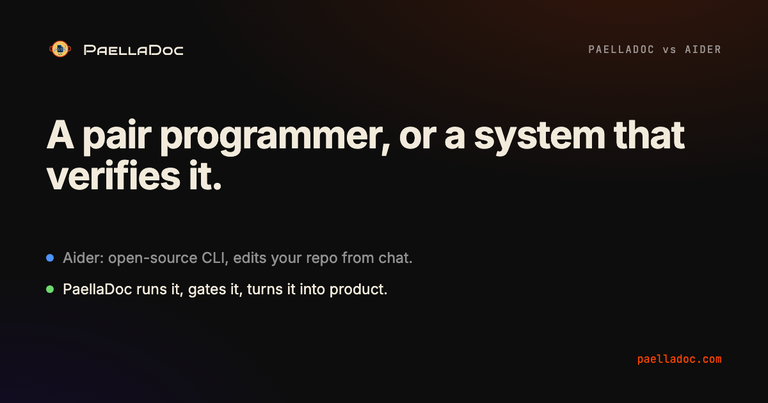
Aider and PaellaDoc both put an AI to work on your real git repo, but they are after different jobs. Aider is a pair programmer in your terminal: you talk, it edits, it commits. PaellaDoc is the layer around that work. It runs a coding agent in an isolated worktree, then decides whether the change is actually done by running it. So this is less “Aider vs PaellaDoc” and more “Aider on its own vs an Aider-style agent running inside PaellaDoc”.
What Aider does
Aider is an open-source command-line AI pair programmer. It lives in your terminal, edits files directly in your git repo, and makes its own commits as it goes. It is model-agnostic, so you point it at whatever model you want, and it is lightweight and scriptable enough to drop into a shell loop or a Makefile. Developers reach for it because it is small, open, fast to start, and it gets out of the way.
None of that is a knock. Aider is one of the most loved CLI agents out there, and for good reason. If you want a tight edit-commit loop in the terminal with no app to install and no opinions imposed on you, it is a great pick.
What PaellaDoc does
PaellaDoc runs coding agents, Aider-style CLI agents included, in isolated git worktrees on your machine. It is local-first, model-agnostic, and bring-your-own-subscription. The part that matters is what happens after the agent stops typing.
PaellaDoc has an execution gate. “Done” is not “the build is green”. “Done” is “the code runs and satisfies the acceptance criteria you wrote first”. The gate runs the change against those criteria and refuses to call it finished until it actually passes. A green build that does the wrong thing does not get through.
Around that gate sits the rest: a product methodology that turns a request into versioned .paella artifacts (a PRD, epics, user stories, acceptance criteria), reverse intake that reads an existing repo and reconstructs its product context, a multi-repo control room for the hundred repos you now have on disk, Telegram remote control so you can start a job or approve a step from your phone, and a no-coder mode that builds a whole product from a description.
The key difference
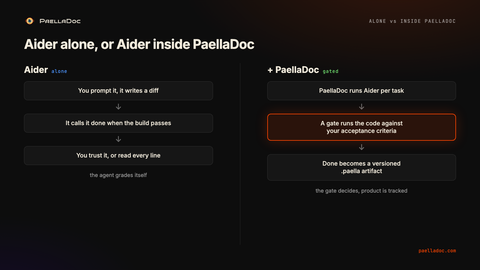
Aider’s loop ends at the commit. It edits, it commits, and it trusts that you, the developer reading the diff, will catch anything wrong. That is the right design for a pair programmer. You are in the chair.
PaellaDoc’s loop ends at the gate. The agent’s commit is the start of verification, not the end of the task. The question PaellaDoc asks is not “did the model produce plausible code” but “does this pass the criteria when we run it”. Same repo, same models, different stopping condition.
Why the gate exists
We ran a public 210-run benchmark to see how often a confident agent is just wrong. A raw agent’s output passed the build but was genuinely wrong 40% of the time. Even the strongest frontier model at max effort failed a hard task two out of three times, and it failed on different runs each time, so you cannot predict which attempt is the bad one. That is the whole argument for the gate: a green build is not a correct feature. If you let an agent commit and call it done, four out of ten of those done cards are lying to you.
Code, or product
Aider produces code. PaellaDoc tries to produce product. The methodology layer is an open SDK, and the community builds and shares four kinds of packs: method packs for how you work, stack packs for your tech stack, design packs for theming and design tokens, and validator packs for the gates themselves. The output is not just a diff in your history, it is a set of versioned, comparable .paella artifacts you can read, diff, and hand to someone else. The framing is simple: you make product, not just code.
PaellaDoc does not replace Aider
This is the important part. PaellaDoc is not an alternative to Aider. It is something Aider can run inside.
If you love Aider’s terminal loop, keep it. PaellaDoc wraps an Aider-style CLI agent in a worktree, lets it do its edit-commit thing, and then runs the gate on top. You get the agent you already like plus an independent check on whether its work holds up. So the answer to “does PaellaDoc replace Aider?” is no. PaellaDoc runs it and verifies it.
What we share
A lot, actually. Both are local-first and work on your real git repo. Both are model-agnostic and bring-your-own-subscription, so you are not locked to one vendor. Both respect the terminal and git as the source of truth.
And Aider is ahead in the places that come from being open and mature: it is open-source with a real community, it is lighter to install and start, it is more battle-tested, and it has years of scriptable use behind it. PaellaDoc is early and built by a solo founder. If polish and a large user base are what you need today, Aider has them and PaellaDoc does not yet.
| Capability | Aider | PaellaDoc |
|---|---|---|
| Works on your real git repo | Yes | Yes |
| Model-agnostic, bring-your-own-subscription | Yes | Yes |
| Local-first, terminal native | Yes | Yes |
| Open-source | Yes | No |
| Maturity, community, polish | Ahead | Early, solo founder |
| Runs in isolated git worktrees | Manual | Yes, built in |
| Execution gate (done = runs against acceptance criteria) | No | Yes |
Versioned .paella product artifacts (PRD, epics, stories) | No | Yes |
| Open SDK packs (method, stack, design, validator) | No | Yes |
| Reverse intake of an existing repo | No | Yes |
| Multi-repo control room | No | Yes |
| Telegram remote control | No | Yes |
| No-coder mode | No | Yes |
Who each is for
Reach for Aider if you are a developer who lives in the terminal, reads every diff, and wants a fast, open, scriptable pair programmer with no app and no ceremony. It is one of the best tools for that, and you are the verification layer.
Reach for PaellaDoc if you want the work checked by running it, not just by reading it. If you want a request to become a PRD, epics, stories and acceptance criteria, if you manage a pile of repos and want one place to drive them, if you want to approve a step from your phone, or if you cannot read a diff at all and still need to ship a product. PaellaDoc can run an Aider-style agent underneath all of that.
PaellaDoc is not better than Aider. It is doing a different job, and for the terminal part of that job, it is happy to run Aider. See the full comparison hub for how PaellaDoc lines up against other tools.