
Cline and PaellaDoc get put in the same sentence a lot, and they shouldn’t be. Cline is an autonomous coding agent that lives inside VS Code: it plans, edits files, runs commands, and acts with real autonomy in your editor. PaellaDoc is not another agent. It is the layer above the agent. It runs CLI coding tools in isolated git worktrees on your machine and then decides whether the work is actually done by running the code against acceptance criteria you wrote first. So the real question is not “Cline or PaellaDoc”. It is “Cline on its own, or Cline inside something that verifies it”.
What Cline does
Cline is an open-source autonomous coding agent that runs as a VS Code extension. You give it a task, and it plans, reads your files, edits them, runs terminal commands, and keeps going with some autonomy until it thinks it’s finished. It is model-agnostic, so you point it at whatever model you want. It is popular for good reasons: it lives right where you already work, it is flexible, the source is open, and you can watch it act step by step inside the editor you already trust.
If your job is “I want an agent that writes and changes code in my editor”, Cline does that job well and it does it today. None of what follows is a knock on that.
What PaellaDoc does
PaellaDoc runs locally and is model-agnostic too, on your own subscription, but it sits one level up from the agent. The pieces Cline does not have:
- An independent execution gate. PaellaDoc does not trust the agent’s own “I’m done”. It takes the real diff the agent produced and runs it against the acceptance criteria you defined up front. A green build is not enough. The feature has to actually do what you said it should.
- Product artifacts in a
.paella/folder: a PRD, epics, user stories, acceptance criteria, all versioned and comparable, built and shared through an open SDK of packs (method, stack, design, validator). You make product, not just code. - Reverse intake of an existing repo: it reads code that’s already there and reconstructs the product context around it.
- A multi-repo control room: in the AI era you end up with a hundred repos on your machine, and PaellaDoc opens, organizes and tags them in one place.
- Telegram remote control: start work, check a gate, approve a step from your phone.
- A no-coder mode that builds a whole product from a plain description, for someone who can’t read a diff.
The key difference: who decides “done”
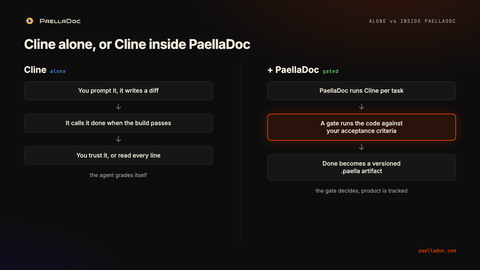
With Cline, the agent decides when it’s finished. It plans, it edits, it runs what it wants to run, and at some point it tells you it’s done. That is the design, and inside the editor it’s a fast loop.
PaellaDoc moves that decision out of the agent’s hands. You write the acceptance criteria first. The agent works in an isolated worktree. Then a gate that the agent does not control runs the code against those criteria and passes or fails the work on the real diff, not on the agent’s self-report. The agent proposes. The gate disposes.
That is the whole bet. An agent that grades its own homework will tell you it passed. A gate that runs your criteria will tell you whether it actually did.
Why the gate exists
We ran a public benchmark, 210 runs. A raw agent’s output passed the build but was genuinely wrong 40% of the time. And even the strongest frontier model at maximum effort failed a hard task two times out of three, failing on different runs each time, so you couldn’t even predict when it would break. That is the gap PaellaDoc is built to catch: a green build is not a correct feature. The compile passing tells you the code runs. It does not tell you the code is right. The gate is the difference between those two.
Code, or product
Cline produces code changes. PaellaDoc tries to make the work into product. The .paella/ artifacts mean the PRD, the epics, the user stories and the acceptance criteria are first-class files, versioned next to the code, comparable across time, and shaped by community packs you can install and share through the SDK. The methodology itself is a pack. So is your tech stack, your design tokens, and your gates. The agent’s diff is the last step in that chain, not the whole thing.
PaellaDoc does not replace Cline
This is the part to be clear about. PaellaDoc does not compete with Cline and it is not trying to take its place. PaellaDoc orchestrates CLI and agent tools, and Cline-style agents are exactly the kind of thing it runs. The frame is “Cline on its own vs Cline inside PaellaDoc”. On its own, Cline edits your code in the editor. Inside PaellaDoc, that same kind of agent runs in an isolated worktree, against product artifacts you defined, with a gate checking the result. You don’t drop Cline to use PaellaDoc. You let PaellaDoc run and verify the agent’s work.
Does PaellaDoc replace Cline? No. Different jobs.
What we share
Both are local-first and both are model-agnostic: you bring your own model and your work stays on your machine. Both run agents with real autonomy. And here is where Cline is plainly ahead: it is open-source, it is popular, it is more polished, and it lives right inside the editor you already use every day. PaellaDoc is early and built by a solo founder. Cline has the maturity, the community, and the in-editor experience that a single person cannot match yet. If editor-native flow is what you care about most, that is a real and current win for Cline.
| Capability | Cline | PaellaDoc |
|---|---|---|
| Autonomous coding agent | Yes | Runs them (Cline, Claude Code, Codex, any CLI) |
| Local-first | Yes | Yes |
| Model-agnostic / bring your own | Yes | Yes |
| Lives inside VS Code | Yes | No (orchestration + control room) |
| Open-source | Yes | No |
| Maturity, polish, community | Ahead | Early, solo founder |
| Independent execution gate (runs code vs criteria) | No | Yes |
| Isolated git worktree per task | No | Yes |
| Product artifacts (.paella: PRD, epics, stories, AC) | No | Yes |
| Reverse intake of an existing repo | No | Yes |
| Multi-repo control room | No | Yes |
| No-coder mode | No | Yes |
| Telegram remote control | No | Yes |
Who each is for
Reach for Cline if you want an autonomous agent that writes and edits code right inside the editor you live in, open-source, flexible, working today. If your loop is “describe a change, watch the agent make it, review it in the diff view”, Cline is a strong fit and it is more mature at exactly that.
Reach for PaellaDoc if your problem is the next layer up: you want the work defined as product first, run by whatever agent you choose in an isolated worktree, and you want “done” decided by a gate that runs your criteria instead of by the agent’s own word. And if you can’t read a diff at all, the no-coder mode is built for you specifically.
PaellaDoc is not better than Cline. It is a different job. Cline acts in your editor. PaellaDoc decides whether what got built is actually right, and it is happy to run an agent like Cline to find out. See the full comparison hub for how it lines up against other tools.